

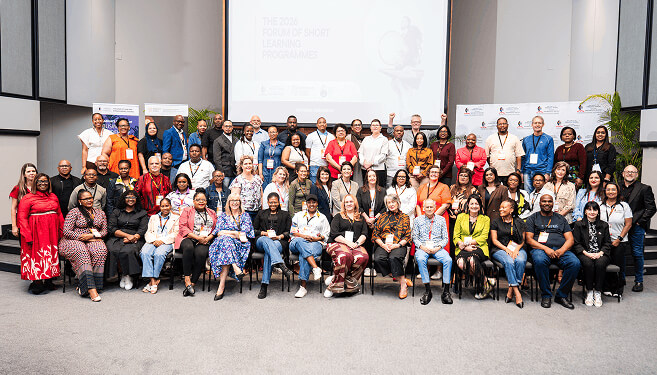
The University of KwaZulu-Natal (UKZN), through its Graduate School of Business and Leadership (GSB&L), hosted the 2026 Forum of Short Learning Programmes (FSLP) bringing together representatives from Higher Education Institutions, business schools, quality assurance bodies and industry to discuss the future of flexible learning.
Held under the theme ‘New Pathways: Perils and Opportunities for Learning and Quality Assurance’, the forum was hosted in partnership with Stellenbosch University and the University of the Free State (UFS).
The 2026 gathering marked the third edition of the FSLP, following events hosted by Stellenbosch University in 2024 and UFS in 2025. The forum reflected growing interest in short learning programmes (SLPs) as universities responded to changing social, economic and workplace needs.
Dr Crispin Hemson, interim head of the short course programme at GSB&L, chaired the forum and moderated discussions with keynote speakers and panellists.
Welcoming delegates to UKZN, Deputy Vice-Chancellor and Head of the College of Law and Management Studies, Professor Ernest Khalema, said the Forum came at a critical time for Higher Education.
“The world of work is changing rapidly. Technology is transforming industries, artificial intelligence is reshaping jobs and business models, and organisations are operating in an environment characterised by complexity, uncertainty and constant change,” he said.
Khalema said organisations were increasingly looking to universities beyond traditional qualifications, seeking knowledge, skills and solutions to address practical challenges and emerging opportunities.
“Our approach to short learning programmes therefore needs to move beyond simply asking, ‘What programmes can we offer?’ We must also consider what problems organisations are trying to solve, what capabilities individuals and institutions need to develop, and how we can create learning experiences that are relevant, credible, accessible and capable of demonstrating meaningful impact,” he said.
Executive Dean and Head of GSB&L, Professor Serestina Viriri, emphasised the importance of the forum as a platform for sharing ideas, strengthening collaboration and addressing challenges facing Higher Education.
Viriri said the rapidly changing environment required flexible, responsive learning models that anticipated future needs. Through programmes such as tailored corporate training and specialised leadership development, GSB&L aimed to connect academic knowledge with the practical needs of organisations and the evolving demands of the workplace.
Viriri also encouraged delegates to maintain relationships beyond the forum and explore opportunities for institutional collaboration.
Keynote speaker Professor Thabo Msibi, UKZN’s Deputy Vice-Chancellor for Teaching and Learning, urged universities to consider carefully the content of their SLPs rather than simply converting existing programmes into shorter formats.
Msibi said universities needed to consider the evolving needs of learners and the knowledge required to prepare them for an increasingly global and rapidly changing workplace.
“The question that we must ask ourselves, as providers in South Africa, is, what type of knowledge should we be offering in our short programmes and in our spaces?” Msibi said.
He also emphasised the need for South African universities to offer locally relevant learning opportunities that prepared students to participate in the global economy.
Msibi identified third-stream income as an important consideration for universities facing financial pressures but cautioned against making revenue generation the sole purpose of SLPs.
He said short learning programmes also served a public-good function by supporting professional development, improving skills in government, business and civil society, and enabling universities to respond to community needs.
The forum also examined the growing use of micro-credentials. Msibi said these could provide targeted learning opportunities and allow learners to build knowledge progressively.
However, he cautioned that universities needed to consider how micro-credentials fitted into their broader academic purpose. Institutions also had to protect the value of established disciplines while responding more effectively to advances in knowledge and technology, particularly artificial intelligence.
The Forum brought together university leaders, SLP practitioners, representatives of quality councils and Higher Education organisations from South Africa and the Southern African Development Community (SADC) region.
Other keynote speakers included Dr Whitfield Green, Chief Executive Officer of the Council on Higher Education, and Professor Petro du Preez, extraordinary professor in Curriculum Studies at Stellenbosch University and the Durban University of Technology.
Discussions covered programme development, the purpose and impact of short learning programmes, micro-credentials, quality and portability, benchmarking, and the implications of artificial intelligence.
A key discussion, titled ‘Beyond the Certificate: Micro-Credentials and the Future of Short Learning Programmes in Southern Africa’, examined how new forms of credentials could support lifelong learning and respond to changing skills requirements while addressing questions of quality and recognition.
The Forum concluded with a discussion titled ‘AI: Perils and Possibilities’, led by UKZN’s Professor Wayne Hugo.
The forum aligned with UKZN’s aspiration to be the Premier University of African Scholarship and its commitment to excellence in teaching and learning.
The two-day gathering enabled institutions to share experiences, question existing approaches and explore opportunities for collaboration. It also highlighted the need to develop a short learning programme system that is responsive, financially sustainable and academically rigorous, with effective quality assurance.
Words: Lungile Ngubelanga
Photograph: Hesper Media